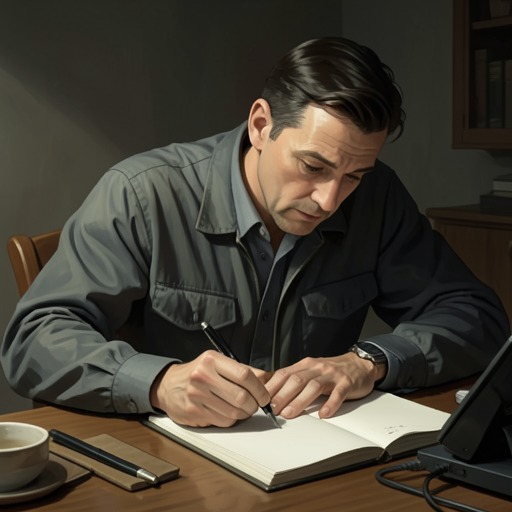
Mike Noonan Resumes Writing
Bag of BonesMike Noonan’s return to writing is a hard-won beginning rather than an instant cure: after four years of writer’s block, he sits down at the IBM Selectric in his office at Sara Laughs and types “Chapter One.” The act transforms the typewriter from a relic beside an abandoned career into a working instrument, and gives him reason to hope that the years without Jo, friends, and work may be over.
The stalled beginning
Before he tries to write, Mike finds an old pink-carbon receipt from Click!, the Castle Rock photo shop where Jo had bought supplies. On its blank side, his earlier typing has left a disorderly sequence of names—Jo, Sara, and Mattie, with Jo’s full name, Johanna, also appearing—followed by the lower-case fragments “normal sperm count,” “sperm norm,” and “all’s rosy.” The page seems to preserve a struggling attempt to report a three-faceted dream even as it was happening; it is evidence of writing, but not yet the new work he is trying to begin.
Mike carries the Selectric into his office and puts it beneath the poster of Richard Nixon. He balls up the pink slip and throws it away, then plugs the machine into the baseboard socket. The small sequence of actions has the suspense of a test he might still fail. His heart pounds as it had when, at thirteen, he climbed toward the high diving board after twice backing down at twelve. The memory makes the problem physical: confidence has come before, but so has the sudden pressure that closes around his chest.
The office contains further reminders of how tentative the attempt is. Mike considers retrieving a fan, then stops, afraid that preparing to work will be wasted if he cannot actually write. He pulls a desk drawer out too hard and nearly drops it on his bare foot; inside is old paper, which he leaves untouched because he has brought a fresher supply. His hands shake as he tries to reseat the drawer. Even sitting at the familiar desk, with its old creaks and rolling casters, does not make the blank page easy.
Switching on the machine
The remembered diving board continues to frame the moment: Mike recalls the spring beneath his bare feet, the green pool, the small faces below, and the steady throb of the air exchangers. In that recollection, the possibility of dying from fear matters as much as the possibility of jumping. He tries to steady himself aloud, but reassurance does not immediately dissolve the fear.
Then he hears Jo’s voice in his mind, unusually shrill in his version of it, urging him to stop dithering and go on. He reaches for the IBM’s rocker switch, remembering that he once discarded his Word Six program from a Powerbook and thought of it as a farewell to an old companion. The contrast is sharp: that earlier gesture marked a loss, while this time he asks for the attempt to work and lowers his hand to the switch.
The machine starts. Its Courier type-ball makes a preliminary turn, and Mike feeds in a sheet of paper despite seeing his sweaty fingerprints on it. He centers the page and types “Chapter One.” Then he waits for the storm to break. The first words do not guarantee a finished novel or a restored career, but they mark the point at which hesitation gives way to a concrete act of composition.
Evidence of a return
The subsequent pages establish that the beginning has held. Later, Mike returns to the office after a phone call, sits at the IBM, and adds a next-note to the bottom of the page he has been working on. He is able to stop for the day because he has been working, not merely preparing or imagining that he might work. He records a reminder to call his research assistant, Ted Rosencrief, about Raiford, Florida, and the prison setting he needs for the developing story. The note also sketches a scene in which Drake travels toward Raiford, stops at a vegetable stand, and talks with its owner about Shackleford. These planning details show the new pages acquiring forward motion and a practical research agenda.
Mike has written eight double-spaced pages. He fans through them, still surprised they exist, and wonders whether the old IBM and Courier type-ball were the key. The question remains open: the evidence is that he is writing again, not that a particular machine has permanently cured the block. The distinction matters because he has had ideas throughout the four-year sabbatical. One seemed strong enough to become a novel; perhaps half a dozen to a dozen were fairly good; most were brief what-ifs that surfaced and vanished. The difficulty had not been a total absence of ideas, but the inability to turn them into sustained written work.
The first pages also revive a familiar way of working. Mike wants only enough research to make an invention vivid, not exhaustive factual mastery. He remembers employing Rosencrief for specific, limited inquiries on earlier projects and looks forward to having a reason to contact him again. Writing returns here as both physical labor at the keyboard and a renewed connection to the habits, resources, and people that support a book.
Grief, relief, and uncertainty
After the unexpected morning’s work, Mike goes down the path toward the lake to wash off the sweat. There are twenty-three railroad-tie steps between Sara Laughs and the water; after only four or five, the magnitude of what has happened catches up with him. His legs give way, and he sits on a tie, trying to muffle his crying with one end of his towel so boaters will not mistake the sound for murder.
The crying holds several feelings at once. Mike grieves the empty years without Jo, friends, and work, while also feeling gratitude that the workless stretch may have ended. He refuses to treat eight pages as proof of a renewed career: one swallow does not make a summer. Yet he believes the pages may be the start of something real. The return therefore remains hopeful but provisional, measured against the long absence that preceded it.
He also understands the tears as a response to danger narrowly escaped. Since Jo’s death, he realizes, he has been walking a white line down the middle of the road; somehow he has been carried out of harm’s way. He does not know who carried him, and leaves that question for another day. When he has cried everything out, he continues to the lake and wades in. The cool water feels like resurrection, giving the scene a physical counter-image to the sweat, fear, and near-collapse in the office. Writing has resumed, but its significance is inseparable from mourning and survival.